
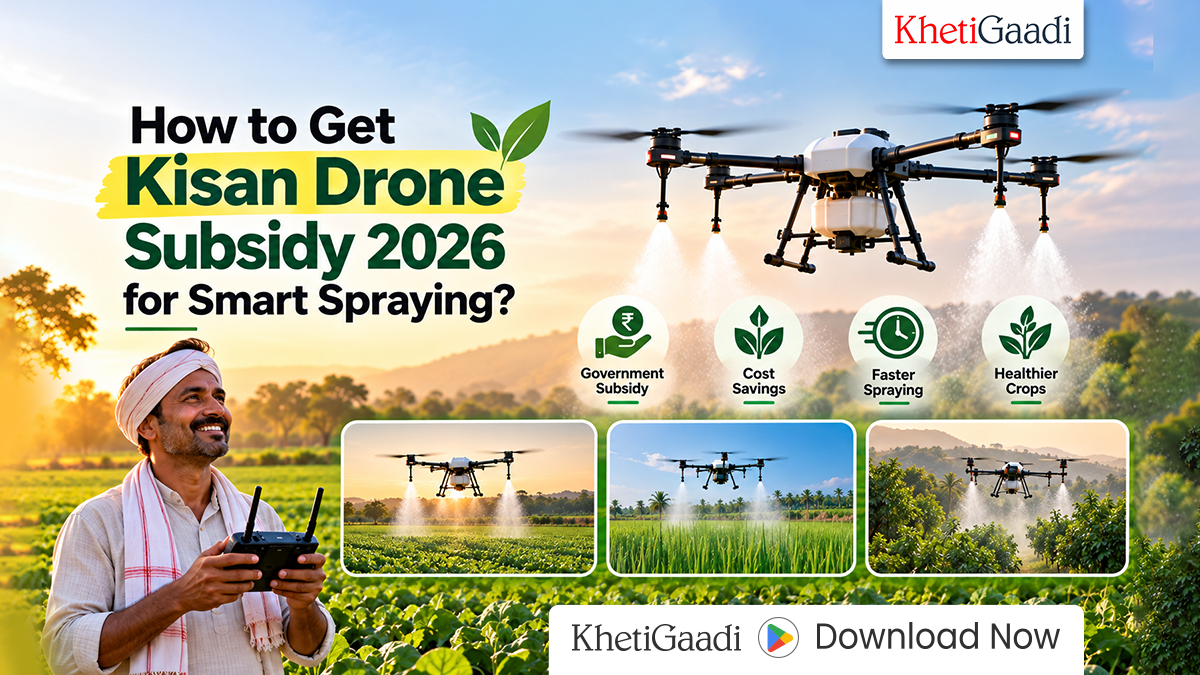
Are you interested in using precision farming with drones that spray? The Ministry of Agriculture and Farmers Welfare gives financial help under Kisan Drone Subsidy 2026. The program runs through Sub-Mission on Agricultural Mechanization (SMAM) and the Namo Drone Didi initiative. This program cuts the cost barrier for buying drones that are approved by the Directorate General of Civil Aviation (DGCA).
Smart spraying technology lets farmers apply fertilizers and crop protection chemicals very accurately. Because of these farmers spend money on chemicals, save water and avoid health risks from manual backpack spraying.
What Is the Kisan Drone Scheme and How Does Smart Spraying Work?
The Kisan Drone initiative pushes farm machines across rural India. Agricultural drones have sensors, GPS guidance and automatic liquid tanks that hold about 10 to 16 liters. They spray crops evenly in a few minutes.
When a farmer sprays by hand he or she might use up to 200 liters of water per acre. Need 3 to 4 hours. Smart drone spraying covers one acre in 7 to 10 minutes. Uses only 10 to 12 liters of water. Also, the tiny droplets delivered cut chemical use by 25–30%.
Who Is Eligible for the Kisan Drone Subsidy 2026?
The program offers levels of financial help depending on who applies and how big the operation will be.
- Individual Farmers: Small, marginal SC/ST and women farmers get subsidy rates.
- Farmer Producer Organizations (FPOs): Registered FPOs and primary credit societies that buy drones for their members.
- Agriculture. Entrepreneurs: Youth who set up Custom Hiring Centres (CHCs) to provide Drone-as-a-Service (DaaS).
- Women Self-Help Groups (SHGs): They can receive grants under the Namo Drone Didi Scheme.
- Institutional Applicants: ICAR institutes, Krishi Vigyan Kendras (KVKs) and State Agriculture Universities (SAUs) that run field demonstrations.
How Financial Assistance Can Applicants Receive?
Financial grants vary according to who applies and what the project looks like. The table below shows the subsidy rates for 2026:
| Beneficiary Category | Subsidy Percentage | Maximum Financial Grant | Primary Scheme / Route |
|---|---|---|---|
| ICAR Institutes / KVKs / SAUs | 100% of drone cost | Up to ₹10.00 Lakh | SMAM (Demonstration Grant) |
| Women Self-Help Groups (SHGs) | 80% of drone package | Up to ₹8.00 Lakh | Namo Drone Didi Scheme |
| FPOs & Cooperative Societies | 75% of drone cost | Up to ₹7.50 Lakh | SMAM Scheme |
| SC / ST / Women / Small Farmers | 50% of drone cost | Up to ₹5.00 Lakh | SMAM Priority Slab |
| Agri-Graduates (CHC Setup) | 50% of drone cost | Up to ₹5.00 Lakh | SMAM Custom Hiring Center |
| General Individual Farmers | 40% of drone cost | Up to ₹4.00 Lakh | SMAM General Slab |
Note: Only Indian-manufactured, DGCA-type-certified drone models registered on the Digital Sky platform qualify for government subsidies.
How to Apply Online for the Kisan Drone Subsidy?
Applications go through the government’s mechanization website. Follow these steps to finish registration:
- Obtain Remote Pilot Certification: Make sure the operator finishes a 5-day Remote Pilot Training Organization (RPTO) course that is approved by DGCA.
- Open the Portal: Go to the central SMAM Agrimachinery Portal. Look at the scheme details on the myScheme Platform.
- Register User: Sign up with your Aadhaar number. Set up your profile as Individual, FPO or CHC.
- Upload Proof Documents: Attach land ownership papers (Khasra/Khatauni) Aadhaar card, bank passbook and Remote Pilot Certificate (RPC).
- Choose Model: Pick a DGCA-certified drone from a listed manufacturer and upload the dealer quote.
- Check and Pay: When the district officer approves and the equipment is checked the subsidy goes into your bank account via Direct Benefit Transfer (DBT).
Key Operational Benefits of Smart Drone Spraying
Buying spraying equipment gives clear benefits for business operators and farmers:
- High Daily Coverage: A 10-to-16-liter drone can cover 30 to 50 acres in one day which helps stop pests quickly when outbreaks happen.
- Big Water Savings: It uses only up to 90% water than normal big sprayers.
- Money from Service: Drone operators who charge ₹300 to ₹600 per acre can earn ₹2,000 to ₹4,000 net each day during busy seasons.
- Health Protection for Operators: Farmers do not touch pesticides or insecticides directly.
Conclusion :
The Kisan Drone Subsidy 2026 speeds up precision farming across India. With subsidy coverage from 40% for growers to 80% for women SHGs under the Namo Drone Didi scheme, smart spraying technology is now affordable. Those who want to apply should get DGCA pilot certification, get dealer quotes and sign up on the Agri machinery portal to receive the state money.
Frequently Asked Questions (FAQ) :
Q. Is a DGCA drone pilot license mandatory to receive the subsidy?
Yes. To get help the drone operator must have a Remote Pilot Certificate (RPC) issued by a DGCA-approved Remote Pilot Training Organization (RPTO).
Q. What is the maximum subsidy available under the Namo Drone Didi Scheme?
The Namo Drone Didi scheme gives selected Women Self-Help Groups (SHGs) an 80% subsidy that can reach up to ₹8 Lakh, for a full drone package.
Q. Can individual farmers apply for a Kisan Drone subsidy?
Yes. Individual small, marginal, SC/ST, and women farmers qualify for a 50% subsidy (capped at ₹5 Lakh), while general category individual farmers qualify for a 40% subsidy (capped at ₹4 Lakh).
Q. Are imported drones eligible for the Kisan Drone subsidy?
No. Only Indian-manufactured drones with valid DGCA type-certification listed on the central Digital Sky platform qualify for financial support under SMAM.