
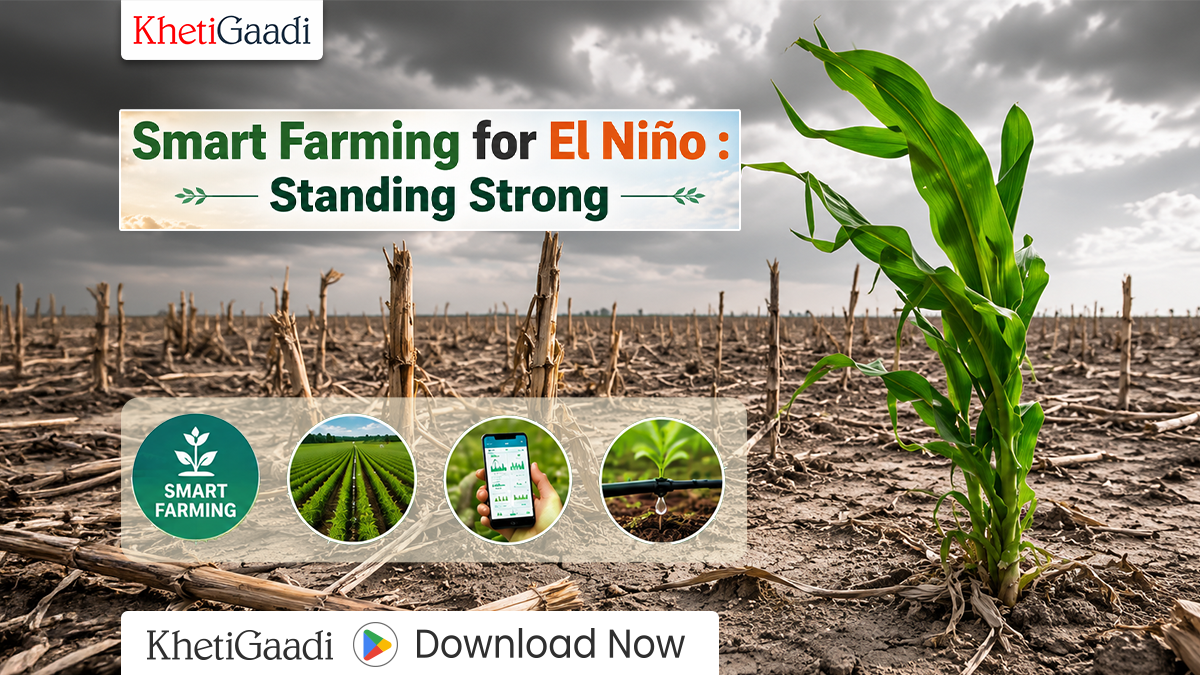
El Niño 2026: Preparing Indian Farmers for Monsoon Disruptions
Weather plays a crucial role in Indian agriculture, where nearly 50% of net cultivated land depends directly on monsoon rainfall. As El Niño warnings gain attention, understanding its potential impact allows farmers to build climate resilience, protect crop yields, and secure farm livelihoods.
What is El Niño?
El Niño is a global climate phenomenon caused by abnormal warming of central and eastern Pacific ocean surface temperatures. For India, this ocean warming frequently weakens southwest monsoon wind currents.
Primary Risk Factors:
- Rainfall Deficits: Delayed monsoon onset and below-average total seasonal precipitation.
- Erratic Distribution: Extended dry spells interspersed with sudden, intense rain events.
- Increased Heat Stress: Higher daily temperatures during critical crop germination and flowering stages.
Impact on Kharif Crops and Vulnerable Regions
Because the Kharif season (sown in June–July) relies heavily on monsoon moisture, rainfall delays disrupt early sowing windows.
- Vulnerable Crops: Paddy (rice), maize, soybean, cotton, pulses, and oilseeds. Insufficient water during growth impairs tillering in paddy, seed setting in maize, and pod formation in pulses.
- High-Risk Regions: Rainfed agricultural belts across Central India, Maharashtra, Karnataka, Telangana, Andhra Pradesh, Rajasthan, Madhya Pradesh, and Gujarat.
Practical Action Plan for Farmers
While weather patterns cannot be controlled, adopting proactive field-level practices significantly minimizes crop loss.
1. Crop Selection & Sowing Management
- Short-Duration Varieties: Shift to early-maturing hybrid seeds that complete their cycle before soil moisture depletes.
- Resilient Choices: Increase allocation toward coarse cereals (Shree Anna / millets), pulses, and oilseeds that require less water.
2. Water & Soil Conservation
- Micro-Irrigation: Deploy drip and sprinkler systems to deliver water efficiently to crop root zones.
- Moisture Retention: Practice zero-tillage, ridge-and-furrow planting, and crop residue mulching to curb evaporation loss.
- Storage Systems: Build farm ponds, check dams, and rainwater structures to store emergency supplemental irrigation.
3. Integrated Farm Practices
- Early Weed Control: Clear weeds within the first 30–45 days to eliminate competition for scarce moisture and nutrients.
- Pest Monitoring: Erratic weather elevates pest risks (stem borers, armyworms, planthoppers). Inspect fields every 5–7 days.
- Income Diversification: Integrate livestock, poultry, horticulture, or agroforestry to cushion against single-crop failure.
Institutional Support & Advisories
The Ministry of Agriculture and ICAR have activated district contingency plans across high-priority rainfed zones. Farmers are encouraged to track district-level Agromet advisories issued by the India Meteorological Department (IMD) via SMS and local extension centers to guide sowing schedules and fertigation.
Frequently Asked Questions
Q. Does El Niño always guarantee a severe drought in India?
A. No. While it increases the probability of a weaker monsoon, regional climate drivers like a positive Indian Ocean Dipole (IOD) can help offset rainfall deficits.
Q. Which crops perform best during prolonged dry spells?
A. Millets (pearl millet, finger millet), pulses (pigeon pea, cowpea), and oilseeds exhibit superior drought tolerance compared to water-intensive paddy.