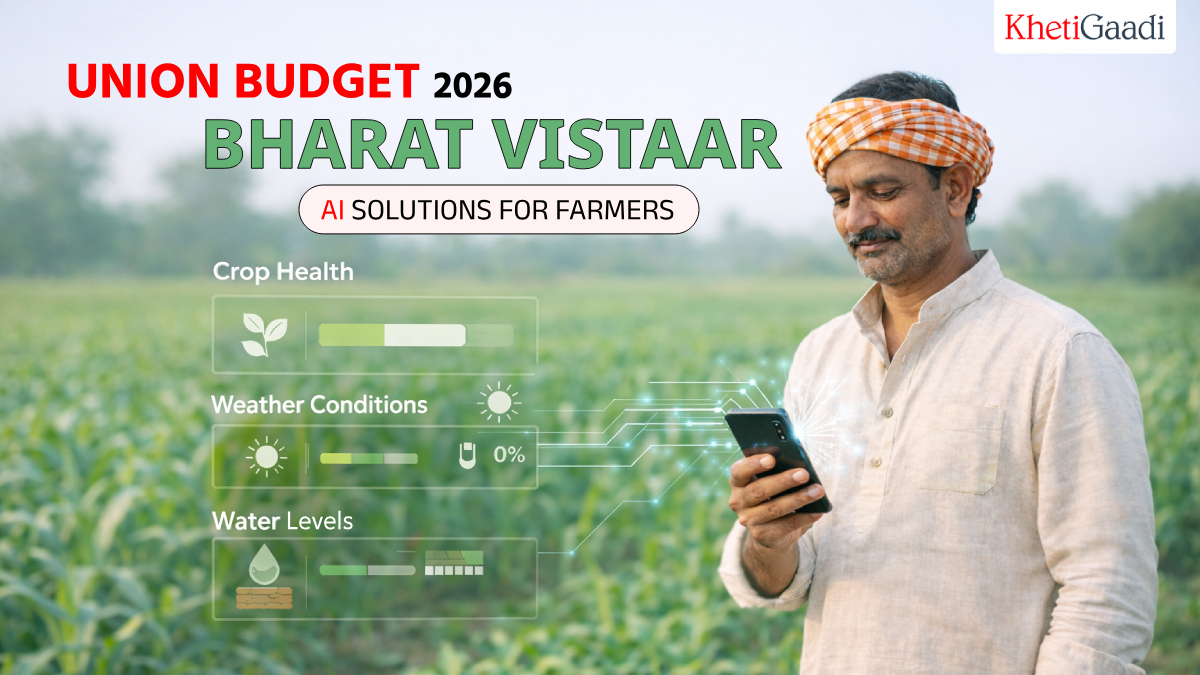
India is more of an agrarian society with about 45% of its workforce based on agriculture and allied activities. Despite substantial reforms and technological innovation the sector has witnessed in the past few decades, challenges persist inability to access timely expert advice; unpredictable weather patterns, pest infestation, poor market connectivity and awareness about government schemes. To meet these challenges and bring in the new era of tech-enabled farming, the Government of India unveiled a pathbreaking artificial intelligence (AI)-based platform Bharat Vistaar (Virtually Integrated System to Access Agricultural Resources).
KhetiGaadi always provides right tractor information
Farming still underpins the Indian economy and about 55-56% of the country’s workforce is employed in agriculture and allied sectors accounting for about 18-19 percent of GVA (gross value added). However, despite being the most important sector of India’s economy and employing a majority of its population, the agriculture sector is often plagued with deep structural challenges, low productivity, weather vagaries, high input costs and inadequate access to timely information and advisories. These challenges were at the core of the discourse on the Union Budget 2026–27, discussing the use of technology to modernise farming, and there was also a discussion about Bharat Vistaar, a multilingual AI tool for farmers.
What is Bharat Vistaar?
Bharat Vistaar (Virtually Integrated System to Access Agricultural Resources) is in the Union Budget 2026–27. The service is a multilingual AI-based digital platform to fill the information gap between scientific agriculture knowledge and on-ground problems faced by Indian farmers.

The silos of digital agriculture would be plugged into it such as AgriStack (a congregation of farmer records/data) and the Indian Council of Agricultural Research (ICAR)-led package of practices and overlaid with artificial intelligence to provide data-driven, context-relevant advisories to farmers.
Key Features of Bharat Vistaar
1. AI-Driven Advisory Services
At the core of Bharat Vistaar is an AI engine that processes a range of data feeds crop status, soil health level in each plot, weather forecast for each location in real time, pest risk likelihoods and past practices to name a few. The tool offers personalized, practical advice for the farmer based on this information and specific to their location and crop type.
This is a quantum leap from the generic advisories in place until now and would facilitate farmers’ decisions at every stage be it sowing, application of plant nutrients or harvesting.
2. Multilingual Accessibility
India’s farmers also speak hundreds of languages and dialects. Bharat Vistaar is multilingual. The advisories and the guidance are disseminated in regional languages for better understanding and easy action of the farmers.
This flexibility means it’s possible to overcome language barriers and broaden the integration of small, marginal, or remote farmers.
3. Integration With Government Systems
Bharat Vistaar is an integration of India’s AgriStack portal (it stores the digital farmer records and services) with the Indian Council of Agricultural Research (ICAR) package of practices. This partnership makes it easier for farmers to access research-validated advice all in one place, rather than having to check various portals.
Armed with such connected data, the AI engine can offer science-backed advice based on localized data and real farm conditions.
4. Weather, Soil, and Pest Insights
Coping with volatile weather patterns and pest infestations is one of farmers’ daily concerns. Bharat Vistaar collates weather data from APIs along with real-time soil health information and provides timely warnings and advisories. This is particularly important during periods of crop sensitivity (eg, during flowering or pre-harvest) when weather decisions can result in dramatic differences in yield.
5. Government Scheme Information and Access
Many farmers are not aware of crucial government welfare schemes, or cannot figure out how to apply for them. Bharat Vistaar is an attempt to address this by having all these key details walking you through one place including basic contacts, eligibility criteria and perhaps even application tracking for various schemes.
Benefits for Farmers
1. Enhanced Decision-Making
With Bharat Vistaar, farmers graduate from guesswork and receive data-supported and customized advisories suitable to their specific locality. With data-driven inputs such as soil health indicators, weather patterns and forecasts, historical crop performances and best practice protocols for a particular region, the platform empowers farmers to make decisions at every stage of the cultivation process.
AI helps in picking appropriate crop varieties and deciding when to sow, how much fertiliser to apply and when to irrigate all of which can lower risk. Farmers therefore are able to better leverage available resources, save on unneeded expenses, and limit the risks related to bad planning or incorrect information.
2. Increased Productivity and Income
Better planning and prompt interventions driven by AI analytics can thus lead to substantial improvement in crop yields with lesser input loss, such as the irrigation cost. Early identification of crops under stress, of pests or poor nutrition can ensure remedial action before damage becomes severe.
Over time, this leads to:
- Higher per-acre productivity
- Lesser seed, fertiliser and pesticide wastage
- Improved cost efficiency
For small and marginal farmers, who are the majority of India’s farming population, these efficiency gains can have a real impact on the ground, with more reliable farm incomes owing to such increases in productivity that result in greater food security and better livelihoods at the household level.
3. Localised and Inclusive Support
One of the main advantages of Bharat Vistaar is its ability to cater for regional and multilingual requirements. As advisories are issued both in local language and in terms easily understood by farmers, it helps them to comprehend as well as apply the advice given.
This diversity is significant in a country like India, where farming methods, crop cycles and challenges differ greatly from region to region. Focalised assistance bears in recommendations are:
- Applications to crops and climate of the region
- Aligned with local farming traditions
- Even farmers with only primary school education can understand it
It helps the rural users to adopt and trust the system in larger extents.
4. Climate Risk Mitigation
Climate variability has now emerged as one of the greatest challenges to Indian agriculture. Bharat Vistaar is trying to solve this problem with real-time weather based advisories, climate alerts and pest outbreak warnings for the farmers.
Timely information allows farmers to:
- Adjust sowing and harvesting schedules
- Protect crops from stormy weather
- Workable watering strategies during dry spells
- Take precautions to prevent pest and disease attacks
Through promoting proactive planning as opposed to reactive measures, the platform minimises crop losses resulting from climate variability and encourages more resilient and sustainable agriculture.
5. Bridging Knowledge Gaps
There has been a long gap between agricultural research and practice at the farm level. Bharat Vistaar- closing the gap By blending AI and combining with data from sources such as ICAR, government extension services, and valid agronomical channels, Bharat Vistaar addresses this divide.
The platform converts complex scientific findings into practical, farmer-friendly applications that can be applied on the farm. This empowers them to adopt:
- Modern farming techniques
- Sustainable practices
- Precision agriculture methods
In the process, Bharat Vistaar is not only optimising farm yields but also enriching India’s broader agricultural knowledge ecosystem.
Supporting Climate-Smart and Sustainable Agriculture
One of the largest challenges to Indian agriculture today is climate change. Traveling north to the south of Kenya, changing climate patterns, from the increasing temperature and erratic rainfall, through regular droughts and floods even crop diseases (new pests are being experienced), is significantly affecting agricultural yields in all regions. Bharat Vistaar is instrumental in combating climate-resilient farming.
Leveraging historical data on climate and real-time weather forecasts, the AI framework is able to advise:
- Climate-suitable crop varieties
- Why not to sow seeds towards the best sowing time?
- Water-efficient irrigation schedules
- Early warnings for heat stress or frost conditions
Through its work to steer farmers toward climate-smart practices, Bharat Vistaar helps prevent crop failures and establish long-term resilience. Eventually, it could help India reach its broader objectives of sustainable agriculture, food security, and reduced environmental burden.
Bharat Vistaar and the Digital India Mission
Bharat Vistaar is closely associated with the vision of Digital India and Viksit Bharat of Government of India. It is a case study of how new technologies such as artificial intelligence can be used at scale to address grass roots challenges.
The platform reinforces India’s expanding digital public infrastructure for agriculture, in addition to others including:
- AgriStack
- PM-KISAN
- Soil Health Card Scheme
- e-NAM (National Agriculture Market)
Bharat Vistaar unifies data and services to minimize fragmentation and delivers a single source of truth for both farmers, policy-makers, and researchers. This integration can also help the authorities to formulate better policies based on real-time indicators from the field.
Impact on Crop Planning and Resource Management
Another important application of Bharat Vistaar is for crop planning. Most of the farmers follow old cropping patterns on their fields and have no regard for market demand, soil suitability or even availability of water. This results in oversupply, low prices and soil/water depletion.
Bharat Vistaar with AI-powered analytics:
- Recommend which crops to grow in different soil and water conditions
- Consider alternative high-value or lower water-need crops
- Suggesting crop rotation plans to sustain the fertility of the soil
This type of guidance informs farmer decision-making in a way that is environmentally and economically sustainable, which positively affects the long-term viability of farms.
Potential Challenges and Considerations
Even though Bharat Vistaar is a historic initiative, its success hinges on overcoming a number of challenges:
1. Digital Literacy and Connectivity
There is still a long way to go in terms of having reliable internet connectivity in many remote and rural parts of the country, which really limits AI-led tools like Bharat Vistaar. There are still millions of farmers who use a basic mobile phone or face patchy network coverage in monsoons, in places that are geographically difficult.
Apart from infrastructure, farmers’ levels of digital literacy vary widely. A vast number of small and marginal farmers may struggle with mobile-based apps, dashboards or AI-driven insights at the snap of their fingers. This makes targeted training programs so important.
To address these, Bharat Vistaar needs the backing of:
- Avoiders of on-ground through KVKs, and extension officers
- Use of simple voice interfaces that are not reliant on reading skills
- Offline and low-bandwidth support for poor connectivity regions
- Demonstration trials at village-level farmer meetings and cooperatives
Building rural digital infrastructure and continued handholding will be key to making sure these AI tools actually empower farmers and don’t leave them behind.
2. Language and Dialect Coverage
India’s linguistic diversity is not just one of its greatest strengths, but also a significant weakness for digital platforms. Bharat Vistaar would have to focus not only on the larger Indian languages, but also dialects used in regions as well as local words farmers use daily.
That said, farming lingo can differ depending on who and where you are. The same crop, insect, or farming practice may go by different names in districts and states. Farmers may find it hard to interpret and trust the suggested recommendations if AI outputs do not match local language intricacies.
Some features of enhanced language and dialect coverage would be:
- Voice-based AI interactions in vernacular languages
- Region-specific agricultural vocabulary and examples
- Tailored advisories according to local cropping system
- Localising through cooperation with state departments.shtml of agriculture
Speak farmer’s language the literal as well as cultural one, and Bharat Vistaar could substantially increase its adoption and usability across a variety of rural landscapes.
3. Trust: The accuracy of AI advice
Trust is the single most important factor for any AI tool in agriculture. Farmers take high-risk decisions on sowing, irrigation, fertiliser use and pest control for where wrong advice will result in huge financial loss. As a result, AI-driven recommendations need to be highly reliable and contextually relevant.
AI systems must account for:
- The soil types, weather and varieties grown in the region
- Region-specific farming practices and constraints
- To prevent obsolete suggestions, real-time data refreshment
Building trust requires:
- Model refinement is ongoing and driven by real-world experience
- Powerful feedback loops that can be used by farmers to share successes or discrepancies
- AI advice is validated with scientists and agricultural experts
- Transparency of how recommendations are generated
Human oversight and linkages with the existing extension services will still be important, at least in the initial period, to ensure that such farmers see Bharat Vistaar as a safe rather than risky experiment.
Conclusion
At a time, when data and technology is disrupting the status quo with high efficiencies, the rollout of Bharat Vistaar represents an unprecedented opportunity for Indian farmers particularly those on small holdings (including marginal farms), as well as resource poor groups. With the integration of AI, multi-lingual capabilities and easy access to official scientific advisories and government schemes, Bharat Vistaar is expected to be a reliable digital farming aide. If executed effectively and backed by relevant training and infrastructure, this AI platform has the potential to revolutionize agricultural decision-making in India empowering its farming community do more with less, become more resilient and further financial inclusion on a mass scale.
Stay connected to the KhetiGaadi WhatsApp channel and get the latest updates on farming innovations and government schemes. Visit KhetiGaadi for more information and guidance.
Contact Khetigaadi for guidance and updates on agriculture schemes for farmers:
Phone: 07875114466
Email: connect@khetigaadi.com

To know more about tractor price contact to our executive