
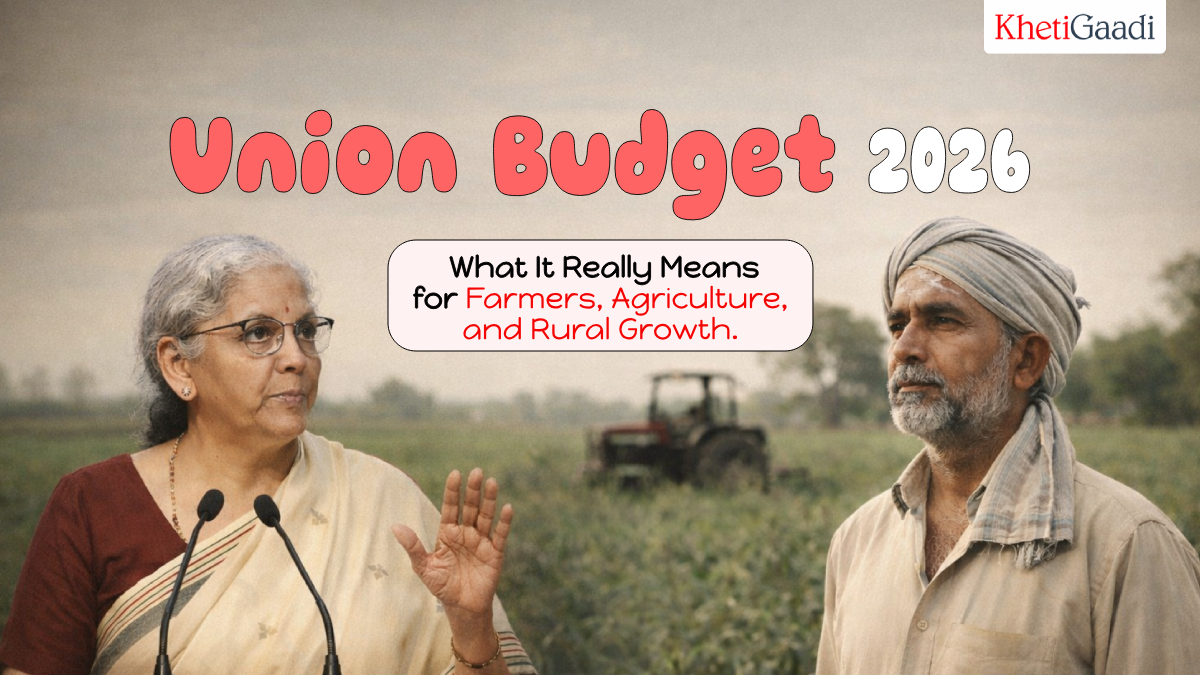
The Union Budget 2026 has evoked mixed feelings among India’s farming populace. In theory, the agriculture sector continues to receive a modest bump in resources. For 2026–27, the government has budgeted the overall agricultural allocation at ₹1.30 lakh crore, a shade more than last year’s estimate. Fertiliser support has crossed ₹1.70 lakh crore, and food subsidy spending is one of the biggest rural safety nets in the country.
KhetiGaadi always provides right tractor information
But numbers alone do not tell the whole tale. That is the fundamental question: How will this budget change the day-to-day life of farmers, tractor owners, and rural workers?
Let’s break it down in easy words.

A Small Increase, Big Expectations
Although allocated funds to the agriculture sector increased by approximately ₹3,000 crore. An increase of 2.6% from previous allotment. That may seem like a boost, but to many who study farm incomes. The increase is modest, given inflation and pressure from climate change as well as rising farming costs.
Despite the image of farmers as simple folks who bend to our will, they have been pulling in more directions than we would like to admit. Even a tiny increase in allocation must now span income support, irrigation, research, machinery, and insurance. That is why many groups of farmers are convinced that the sector requires a much stronger push.
That said, the budget does include targeted investments that have the potential to reshape farms if distributed as they should be.
Income Support Remains Stable
The government, however, has refrained from cutting the ₹63,500 crore provision for farmer income support programmes. This mechanism acts as a safety net for small farmers. It’s not more, but it allows for continued stability.
For many families, this assistance helps pay for seeds and fertilizers and supports basic household needs. It may not be a magic solution to every financial illness, but it avoids sudden shocks.
Farmers often say, putting constant help for something is better than making tacit promises.
Fertiliser and Input Relief
The fertiliser budget has risen to ₹1.70 lakh crore, a jump of almost 8.5 %. This is significant because the price of fertilizer determines the profitability of a crop. No subsidy support means that farming costs will increase sharply.
The government is also doing its bit by keeping fertilizer subsidies intact and thus indirectly supporting crop margins. This is crucial for wheat, rice, sugarcane, and cotton growers who make heavy use of nutrient inputs.
With less input stress, farmers can concentrate on productivity instead of just survival.
Technology Push: AI in Agriculture
Artificial intelligence is one of the contemporary exceptions. Budget 2026 allocates ₹150 crore for AI-backed farming solutions. A new multilingual digital platform will help farmers access advisory services, weather forecasts, soil directions, and crop planning tools.
This action is a step towards smart farming. Technology can minimize guesswork and boost precision. Farmers who have access to digital tools are much more likely to make well-informed choices about irrigation, pest control and harvest timing.
In other words: better advice generates higher income.
Tractor and Farm Machinery Impact
While names of specific tractor brands have not been given in the budget, higher agricultural credit and mechanization support. Add positive sentiment for those looking to buy tractors and equipment manufacturers.
With rural credit flowing well, farmers will happily invest in machinery. The availability of loans and subsidies makes tractors, harvesters, sow- drills and irrigation pumps affordable.
A more diversified machinery cluster yields benefits in several ways:
- Faster farm operations
- Reduced labor burden
- Higher productivity
- More jobs in repair and servicing locales in rural areas
- Increase in the manufacture of tractors and implements
Mechanization is not a luxury anymore – but rather has evolved to become an imperative in farming.
Implements and Infrastructure Support
The government has also increased spending on rural infrastructure and farm equipment. Investments in storage facilities, cold chains, and transport decrease post-harvest losses. Farmer infrastructure ensures that crops also come to markets in better condition and bring higher prices.
There’s also now a fresh emphasis on lucrative crops like coconut, cashew and speciality nut cultivation with the ₹350 crore diversification course launched. It helps farmers shift from growing traditional crops and into lucrative markets.
Diversification mitigates risk and offers you more income opportunities.
Research Budget Concerns
The life of research and operational funding has grown. Even if the allocation for agriculture research was fractionally below previous levels. Experts fear this could impede innovation in seeds and climate resilience, and sustainable practices.
Research is the foundation of long-term growth. Lack of investment in science may mean future productivity will be crippled. A number of agricultural economists recommend that research investments ought to match the magnitude of climate challenges faced by farmers.
Farmers’ Reactions and Ground Reality
Few farmers’ organizations were, however, disappointed. Their main concerns include:
- No legal entitlement for MSP
- No direct farm debt relief
- Some limited steps for drought-hit areas of crops
- Insufficient focus on climate risk
Farmers don’t want luxury they simply want security. Increasing debt and unpredictable weather are still squeezing into rural households.
The budget has provided continuity, but there are few who won’t argue it is one with the potential to be truly transformative.
What This Budget Could Change
Even so, there is some hope that Budget 2026 could see things slowly getting better:
- More affordable inputs
- Easier access to machinery loans
- Better digital advisory tools
- Stronger infrastructure
- Support for crop diversification
The key impact will hinge on how this is implemented. When money gets to the ground smoothly, farmers are going to feel it in a bad way.
Final Thoughts
The agriculture budget isn’t just a matter of accounting. It is indicative of a country’s respect for its food producers. Budget 2026 reflects a guarded optimism — some progress, but no giant leap.
To farmers, tractor owners, and rural entrepreneurs, the message is clear. There is help, but to expand it will take not only government action but also local innovation.
When policy meets the soil, that’s real progress. India’s farming future won’t be determined by numbers alone — it will be marked by the way those numbers intersect with real lives.
Stay connected to the KhetiGaadi WhatsApp channel and get the latest updates on farming innovations and government schemes. Visit KhetiGaadi for more information and guidance.
Contact Khetigaadi for guidance and updates on agriculture schemes for farmers:
Phone: 07875114466
Email: connect@khetigaadi.com

To know more about tractor price contact to our executive